dsh-sandbox-allowlist
Run the following command in DeepSeek Harness:
dsh plugin install developerdh/dsh-sandbox-allowlist
Paste the following prompt into your AI chat to install this plugin:
Run dsh plugin install developerdh/dsh-sandbox-allowlist in DeepSeek Harness to install; the source code is at https://github.com/developerdh/dsh-sandbox-allowlist
About this plugin
DSH ships with a sandbox that confines every write to the workspace directory. The moment a CLI command or the write/edit tool needs to reach a trusted path outside that boundary—such as a shared repository, a build-artifacts tree, or a config folder—you are left with two unappetising options: approve every single operation by hand, or switch the sandbox off entirely. dsh-sandbox-allowlist closes that gap: you declare a set of trusted writable directories and the restricted process writes to them directly, with no per-command prompts and no loss of isolation.
The plugin layers three complementary permission mechanisms on top of the stock sandbox. First, trusted write directories accept glob patterns (** for subtrees, * for one level, ? for a single character). On Windows the plugin materialises an inherited Write ACE for the workspace SID; on Linux it appends a bwrap --bind line. Removing a directory from the config triggers automatic ACL reclamation, so revocation is as close to instant as it gets. Second, a command allow-list matches on shell tool plus pattern and resolves to allow, ask, or deny—modelled after the permission-rule design found in opencode and Claude Code, with wildcards to ignore arguments for prefix-based pass-through. Third, noRead rules let you block or gate the model's file reads by filename or path pattern, with deny for hard blocks and ask for approval, plus built-in guardrails that reject over-broad rules such as anchoring a drive root. Every rule is editable live in a three-card settings UI; changes hot-apply without a restart.
The plugin is built for DSH operators who run AI agents in production but find the default workspace boundary too narrow for real team workflows: you want the agent to write to a handful of authorised project directories, execute common build or test commands without a prompt, and keep sensitive keys out of the model's reading path—all while the sandbox remains fully enabled, with no need to flip between full-trust and full-sandbox mode.
Use Cases
- Agent writes to shared build directories outside the workspace without per-operation prompts
- Block or gate model access to sensitive files like .pem keys and .env configs via deny or ask
- Allow common CI commands such as git status and npm test to run without approval while others still require it
Best For
- Teams running AI agents in DSH that must write to trusted directories outside the workspace
- Operators who prefer per-command approval control over all-or-nothing sandboxing
- Security leads who need to restrict model reads of sensitive files such as keys and credentials
Related Plugins
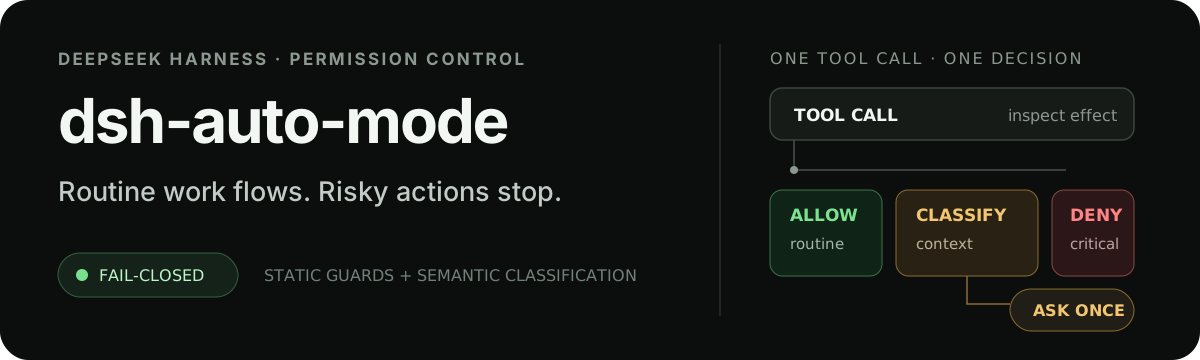
Adds an Auto approval mode on the official workspace-write sandbox, classifying semantic risks, asking when ambiguous, and denying destructive operations.

Undo/rollback system for DSH: config & plugin snapshots, one-click undo/redo/restore, message-level revert, secret masking, safe mode, and offline WebUI/GUI/CLI rescue tools for when DSH won't start.
Packages all 87 SKILL.md files from upstream reverse-skill as a DeepSeek Harness plugin that auto-registers them for authorized reverse engineering, penetration testing, and security research.
Dockyard DSH is a native DeepSeek Harness plugin that unifies official OAuth/client sessions for Codex, Antigravity, Grok, Claude, and Cursor, providing account pool, model catalog, and quota status.