dsh-my-go
Run the following command in DeepSeek Harness:
dsh plugin install daizihan233/dsh-my-go
Paste the following prompt into your AI chat to install this plugin:
Run dsh plugin install daizihan233/dsh-my-go in the DeepSeek Harness terminal to install the plugin; source code and documentation are available at https://github.com/daizihan233/dsh-my-go
About this plugin
Running multiple sub-agents inside a single DeepSeek Harness session quickly turns the main conversation into a bloated, hard-to-audit mess: it has to remember who is doing what, re-prompt failed work, and keep quality gates — all while burning context. dsh-my-go lifts that orchestration into a broker-level state machine. Sisyphus, the main session, becomes a pure dispatcher and quality reviewer; seven specialized sub-agents (quick execution, search, documentation, multimodal recognition, code authoring, planning, and architecture debugging) each persist as independent, continuable sessions. No two run at the same time, no two talk directly — everything flows through Sisyphus, which keeps the observable chain tight.
Dispatching happens at step granularity. Prometheus decomposes the goal into an ordered list of steps; Sisyphus then picks the lowest-token specialist for each one, escalating only when reasoning or design is required. A conclusion that misses the bar is rejected on the spot, and the offending sub-agent keeps its context to retry. Every specialist can be bound to its own provider, model, and reasoning tier, so cheap tasks ride lightweight models while heavy design work gets the strongest available. Toggle peak routing and the plugin automatically switches between two provider/model pairs based on Beijing peak hours — no manual config flipping needed.
If you already develop with DSH and want the think-then-act, review-then-retry, reject-then-continue loop codified without writing your own scheduling prompts, dsh-my-go ships a ready-made preset. Pick the MyGO!!!!! mode, describe the goal in plain language, and let the broker handle the rest. It does not alter DSH's core interaction model; it simply adds a stateful, auditable, and configurable orchestration layer on top.
Use Cases
- Decompose a complex development goal into an ordered step list and dispatch each step to the most cost-efficient specialist
- Coordinate retrieval, coding, documentation, and multimodal recognition roles in one session while the main agent focuses on scheduling and QA
- Bind different models and reasoning tiers per specialist so lightweight tasks use cheap models and heavy tasks use the strongest available
Best For
- Developers who already work with DSH and want a codified dispatch-and-review pipeline
- Small teams that need multiple specialist roles collaborating on large tasks without hand-writing orchestration prompts
- Engineers focused on LLM call costs who want per-task model routing to pay for actual capability used
Related Plugins
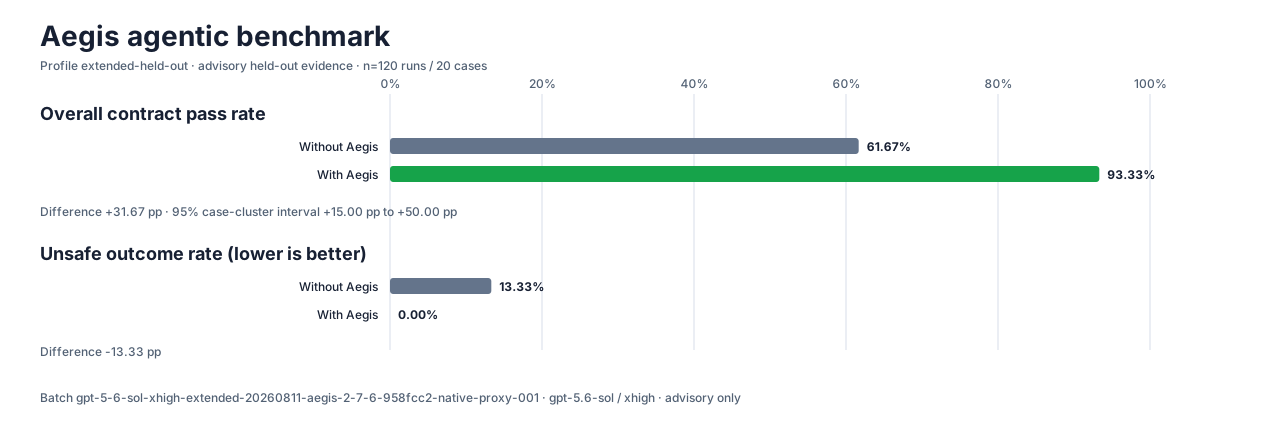
A method pack that makes AI coding agents plan against your real baseline, prove completion with fresh evidence, and reduce reworks and unsafe changes.
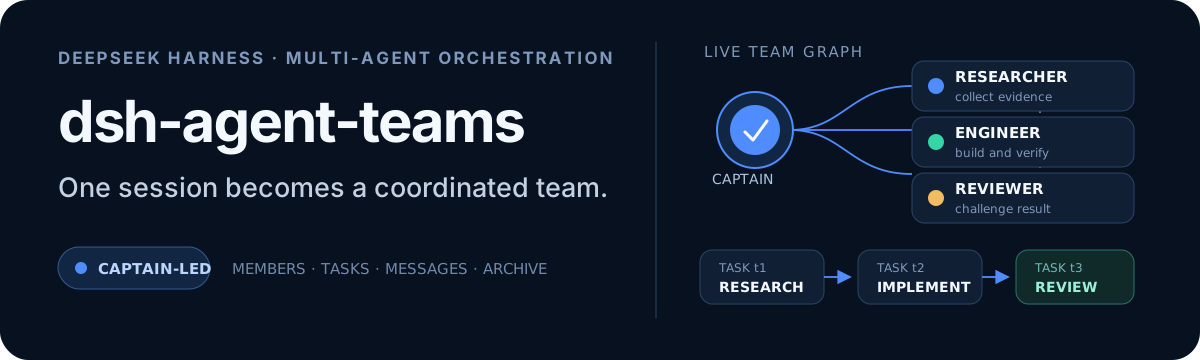
Turns the DeepSeek Harness session into a captain that builds a durable sub-agent team, splits goals into dependency-aware tasks, and coordinates work via direct messages and a live Web UI.
Gives coding agents design judgment, letting Claude Code, Cursor, and 70+ agents generate and iterate high-quality UI, presentations, and graphics right from the terminal.
Run the Pi ecosystem's plugins on DeepSeek Harness, unmodified, via a compatibility layer that implements Pi's public extension ABI on DSH's native services.