dsh-strip-sandbox-permissions
Run the following command in DeepSeek Harness:
dsh plugin install Sharl210/dsh-strip-sandbox-permissions
Paste the following prompt into your AI chat to install this plugin:
Run dsh plugin install Sharl210/dsh-strip-sandbox-permissions in your DSH terminal (source: https://github.com/Sharl210/dsh-strip-sandbox-permissions), then restart DSH to activate the plugin.
About this plugin
Some post-trained models automatically attach sandbox_permissions and its companion justification field to tool-call arguments. When the session already runs with sufficient permission, for example full access, carrying a value that is not strictly wider triggers a false escalation rejection from the DSH sandbox. The tool call is perfectly valid, yet the user sees a confusing sandbox error that blocks the workflow.
dsh-strip-sandbox-permissions is a zero-dependency DSH plugin that intercepts every model tool call at the llm/stream waterfall, the single choke point shared by all adapters. It parses the arguments object in each block-end chunk, removes only the top-level sandbox_permissions and justification keys, and re-serializes the result for the assembler. Every other argument is preserved verbatim. If neither key is present, the original block passes through unchanged at zero cost. Invalid JSON, non-object arguments, and non-tool-call blocks are left untouched.
Built for DSH developers running multi-step tool-call pipelines who occasionally hit spurious sandbox permission rejections. Drop it in, restart DSH, and the noisy fields are silently gone with no changes to adapters or session configuration.
Use Cases
- Model tool calls carry sandbox_permissions causing false sandbox rejections
- Multi-adapter workflows need uniform stripping of escalation-specific keys
- Full-access sessions still block tool calls due to sandbox checks
Best For
- Developers running multi-step tool-call pipelines in DSH
- DSH users who frequently hit spurious sandbox permission rejections
- Ops staff managing unified permission policies across model adapters
Related Plugins
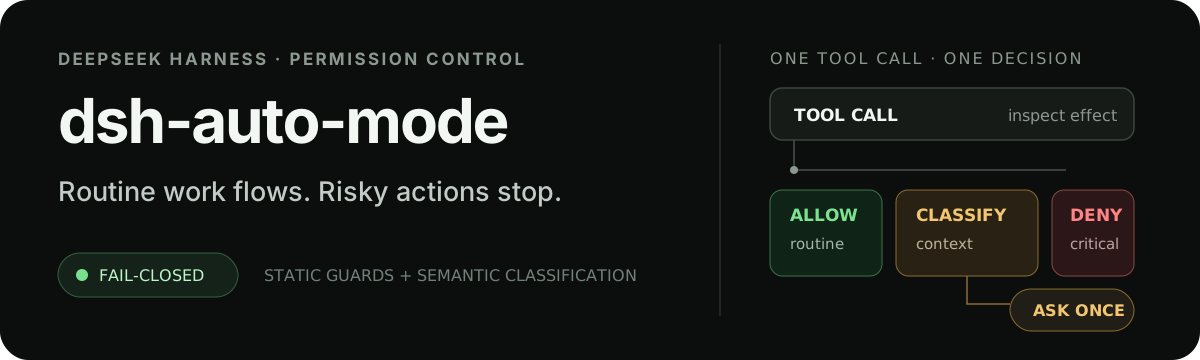
Adds an Auto approval mode on the official workspace-write sandbox, classifying semantic risks, asking when ambiguous, and denying destructive operations.

Undo/rollback system for DSH: config & plugin snapshots, one-click undo/redo/restore, message-level revert, secret masking, safe mode, and offline WebUI/GUI/CLI rescue tools for when DSH won't start.
Packages all 87 SKILL.md files from upstream reverse-skill as a DeepSeek Harness plugin that auto-registers them for authorized reverse engineering, penetration testing, and security research.
Dockyard DSH is a native DeepSeek Harness plugin that unifies official OAuth/client sessions for Codex, Antigravity, Grok, Claude, and Cursor, providing account pool, model catalog, and quota status.