dsh-code-reading-coach
Run the following command in DeepSeek Harness:
dsh plugin install tobysunsun/dsh-code-reading-coach
Paste the following prompt into your AI chat to install this plugin:
Install it in DeepSeek Harness by running dsh plugin install tobysunsun/dsh-code-reading-coach (source: https://github.com/tobysunsun/dsh-code-reading-coach), then restart dsh and pick the Code Reading Coach preset in the preset selector of a new session.
About this plugin
Reading a paper and understanding its open-source implementation are two very different skills. Papers have a fixed skeleton; repositories do not. Most developers and researchers open a new repo after finishing a paper and immediately freeze, unsure whether to start at main.py, look at the test suite, or trace a single function call. dsh-code-reading-coach is a DeepSeek Harness Agent preset that removes that paralysis by guiding you through a structured five-stage method, asking only one question and giving only one next step at a time.
The five stages—Anchor, Terrain, Entry, Core Mapping, and Close the Loop—progress from distilling paper claims into code-level questions, to confirming you know the language and framework, to tracing a minimal execution path, to reading core modules and mapping each claim to its implementation, and finally to running a test, hand-tracing a data flow, tweaking a single line, and paraphrasing the result in your own words. Each stage yields a concrete artifact (claims list, terrain map, execution-flow diagram, mapping table, study notes), and everything persists to a workspace notes.md file so the session can be resumed across conversations.
The preset adapts its walkthrough to the repository type (training framework vs. kernel library vs. model repo), offers three depth levels with a built-in Feynman checkpoint, and explicitly flags any contradiction between paper and code. It is ideal for students and researchers digesting AI/ML papers, for engineers tasked with understanding an inherited codebase, and for anyone who wants a repeatable, low-pressure way to go from "I cloned the repo" to "I can explain the whole system."
Use Cases
- You finish a research paper and open its companion repo but have no clear entry point
- You inherit an unfamiliar codebase and need a structured path to system-level understanding
- You want to verify that each paper claim is faithfully implemented in the code
Best For
- Researchers and graduate students working through AI or systems papers
- Engineers tasked with understanding an open-source codebase
- Developers who prefer a structured, step-by-step approach to reading unfamiliar code
Related Plugins
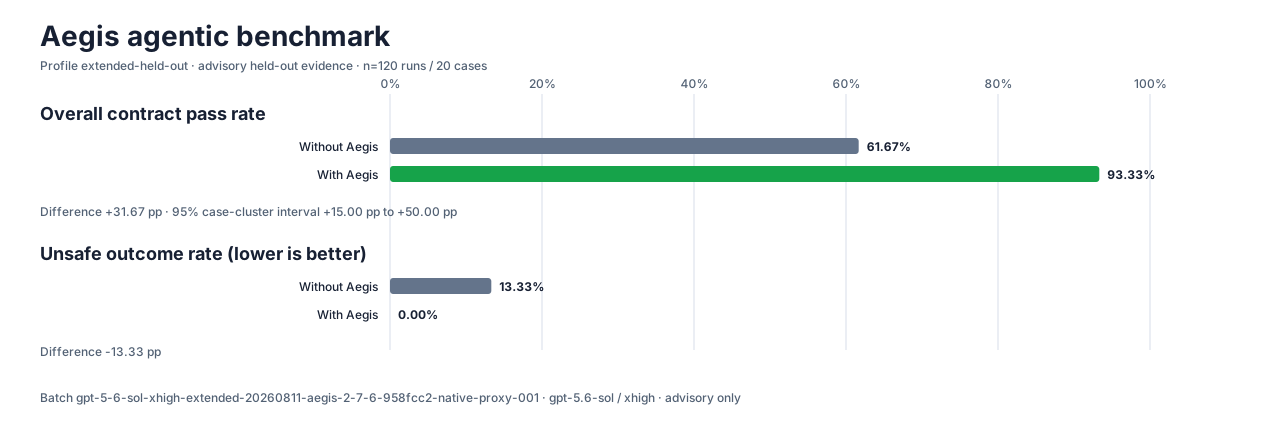
A method pack that makes AI coding agents plan against your real baseline, prove completion with fresh evidence, and reduce reworks and unsafe changes.
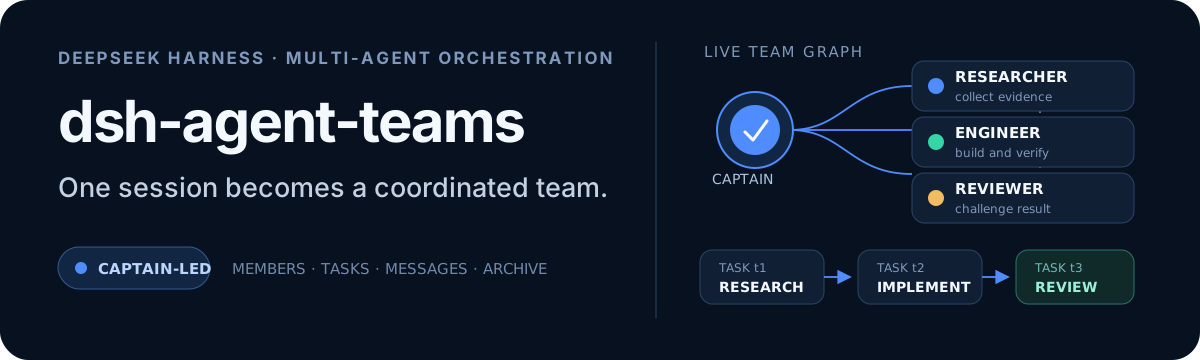
Turns the DeepSeek Harness session into a captain that builds a durable sub-agent team, splits goals into dependency-aware tasks, and coordinates work via direct messages and a live Web UI.
Gives coding agents design judgment, letting Claude Code, Cursor, and 70+ agents generate and iterate high-quality UI, presentations, and graphics right from the terminal.
Run the Pi ecosystem's plugins on DeepSeek Harness, unmodified, via a compatibility layer that implements Pi's public extension ABI on DSH's native services.