dsh-thunderforge
Run the following command in DeepSeek Harness:
dsh plugin install oneinitAI/dsh-thunderforge
Paste the following prompt into your AI chat to install this plugin:
Run dsh plugin install oneinitAI/dsh-thunderforge in your terminal to install the plugin; source code is available at https://github.com/oneinitAI/dsh-thunderforge
About this plugin
Building, debugging, and shipping plugins for the DeepSeek Harness usually means hopping between scaffolding tools, environment managers, payload tracers, and conversation replays, with no single toolchain to tie them together. ThunderForge collapses that fragmented workflow into five interlocking engines activated by one plugin install. Scaffold outputs carry built-in smoke tests out of the box; the debugger aligns session logs with captured LLM payloads at millisecond granularity; and the profile engine spins up an isolated dev preset without ever touching your existing configuration.
Each engine covers a distinct stage of the lifecycle. Capture registers a transparent proxy that masks secrets and writes a structured index stream of every LLM payload. Skills layers a four-tier knowledge base on top of an adaptive-expression layer that passively observes the conversation, builds a live profile of the users proficiency and domain gaps, and adjusts response depth on the fly. Scaffold generates dependency-free plugin templates conversationally, emitting debug hooks and smoke assertions in the same pass. Debugger merges the capture index with session logs into a dual-source trajectory waterfall, so root-cause analysis no longer requires re-running the entire session. Profile creates a sandboxed dev preset that keeps the plugin under test fully decoupled from production config. Every output feeds the next engine, forming a closed loop from creation to release.
If you are building DSH plugins from scratch, debugging LLM call chains repeatedly, or establishing a repeatable plugin development baseline for your team, ThunderForge turns every stage into a conversational, traceable, and reversible step.
Use Cases
- Generate a dependency-free DSH plugin skeleton with built-in smoke tests and debug hooks
- Align session logs with captured LLM payloads at millisecond granularity to trace root causes
- Spin up a sandboxed dev preset for the plugin under test without touching existing profiles
Best For
- Developers building or iterating plugins for the DeepSeek Harness
- Agent engineers who repeatedly debug LLM call chains and tool-call trajectories
- Small teams looking to establish a reproducible, traceable plugin development baseline
Related Plugins
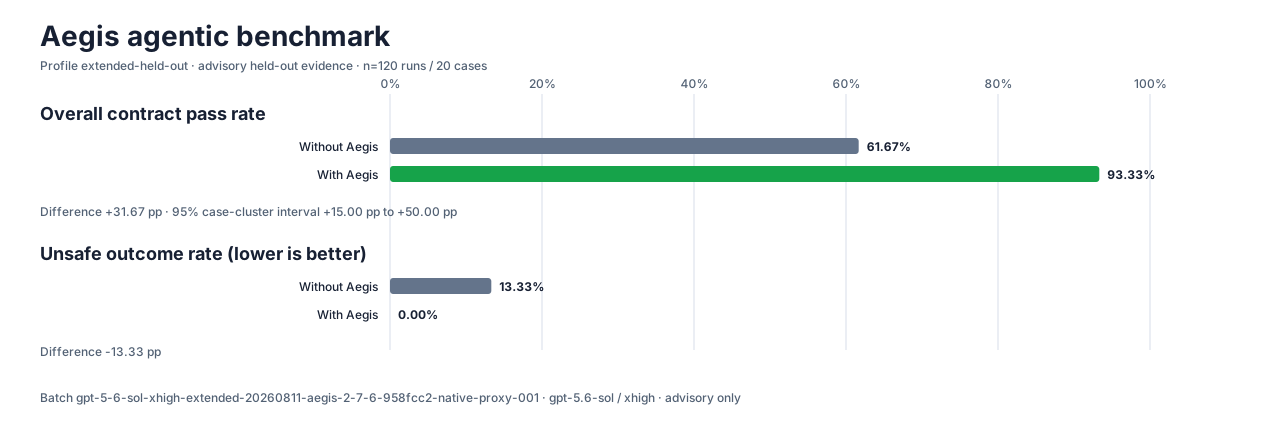
A method pack that makes AI coding agents plan against your real baseline, prove completion with fresh evidence, and reduce reworks and unsafe changes.
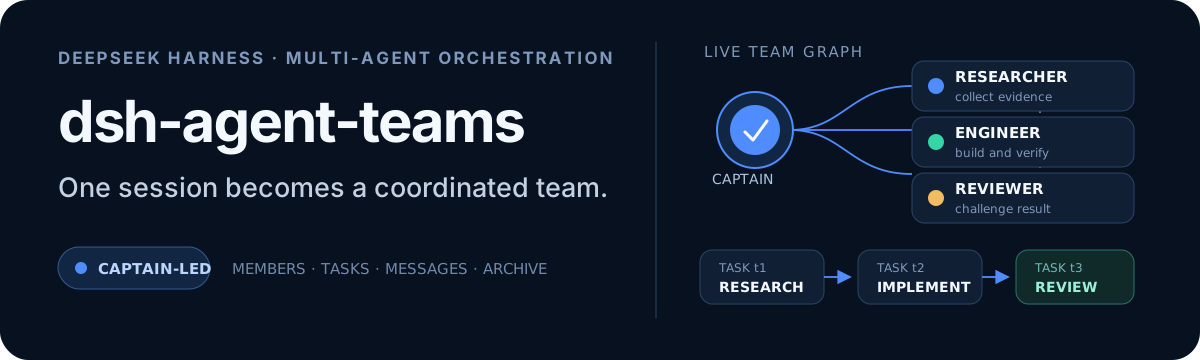
Turns the DeepSeek Harness session into a captain that builds a durable sub-agent team, splits goals into dependency-aware tasks, and coordinates work via direct messages and a live Web UI.
Gives coding agents design judgment, letting Claude Code, Cursor, and 70+ agents generate and iterate high-quality UI, presentations, and graphics right from the terminal.
Run the Pi ecosystem's plugins on DeepSeek Harness, unmodified, via a compatibility layer that implements Pi's public extension ABI on DSH's native services.