dsh-refactor-insight
Run the following command in DeepSeek Harness:
dsh plugin install duyanta123/dsh-refactor-insight
Paste the following prompt into your AI chat to install this plugin:
Run dsh plugin install duyanta123/dsh-refactor-insight in DeepSeek Harness to install; the source repository is https://github.com/duyanta123/dsh-refactor-insight
About this plugin
Inheriting a codebase that has been running for years without anyone daring to touch it is rarely about finding problems—it is about knowing what to fix first, how much to change, and which refactors will trigger cascade failures. dsh-refactor-insight turns that judgment call into an executable, priority-ordered refactoring plan with line-level location, severity ranking, and dependency sequence. It is a structural health check, not a line-by-line diff review.
The plugin ships six deterministic code-smell rules: oversized files, deep nesting, TODO/FIXME density, long functions, god objects, and tightly coupled modules (including Tarjan cycle detection). Every threshold is overridable via CLI parameters, and the scanning layer is dependency-free and fully deterministic. An LLM refinement layer then trims false positives and annotates each finding with severity, estimated cost, and a recommended action. The deliverable is a structured REFACTOR-PLAN.md generated from a documented template; the plugin never modifies source code on its own, and high-risk refactors require explicit human sign-off. Language recognition covers Python indentation blocks, JavaScript/TypeScript brace pairing, and Go receiver methods, and the diagnostic scripts also run standalone on Node.js without the DSH runtime.
If you are maintaining a legacy system that is slowly bloating, inheriting a third-party repository with sparse documentation, or need to communicate to stakeholders which modules will be touched and in what order, this plugin consolidates scattered code smells into a single, actionable refactoring roadmap.
Use Cases
- Gaining a clear refactoring priority and dependency order when onboarding to a legacy codebase
- Explaining to stakeholders which modules will change and why in that sequence
- Generating periodic structural health reports in agent workflows or CI pipelines
Best For
- Engineering teams maintaining large legacy codebases under technical-debt pressure
- Developers inheriting third-party repositories with sparse documentation who need a structural overview before making changes
- Engineers orchestrating code-quality analysis and refactoring decisions in DSH agent workflows
Related Plugins
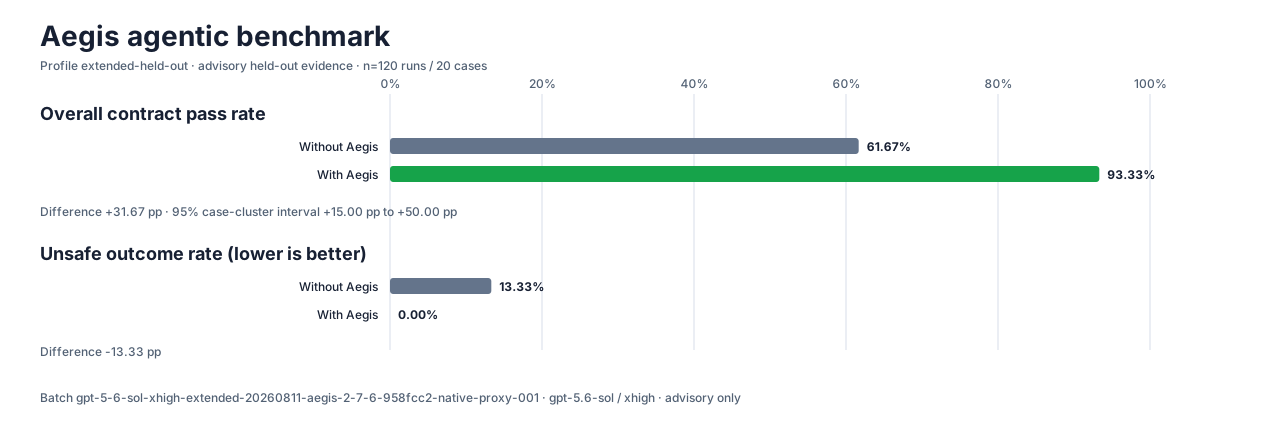
A method pack that makes AI coding agents plan against your real baseline, prove completion with fresh evidence, and reduce reworks and unsafe changes.
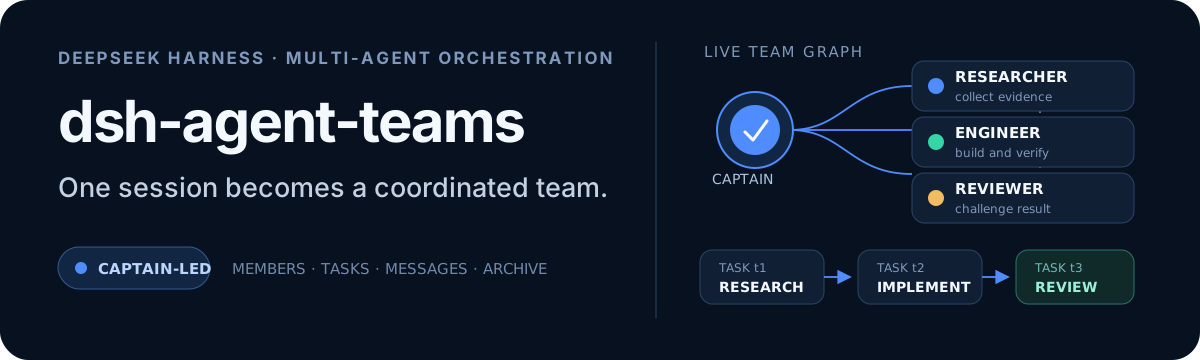
Turns the DeepSeek Harness session into a captain that builds a durable sub-agent team, splits goals into dependency-aware tasks, and coordinates work via direct messages and a live Web UI.
Gives coding agents design judgment, letting Claude Code, Cursor, and 70+ agents generate and iterate high-quality UI, presentations, and graphics right from the terminal.
Run the Pi ecosystem's plugins on DeepSeek Harness, unmodified, via a compatibility layer that implements Pi's public extension ABI on DSH's native services.