computer-control
Run the following command in DeepSeek Harness:
dsh plugin install JohnXu22786/computer-control
Paste the following prompt into your AI chat to install this plugin:
Run dsh plugin install JohnXu22786/computer-control in the DeepSeek Harness terminal to install the plugin; the source repository is available at https://github.com/JohnXu22786/computer-control .
About this plugin
When an AI agent needs to actually drive a desktop computer, it requires a reliable and safe low-level channel. computer-control fills that gap for dsh agents: it lets the model capture the screen for observation, inject precise mouse and keyboard events, and perform semantic actions through the Windows UIA accessibility tree rather than relying solely on brittle pixel-coordinate clicks. The plugin provides a complete capability set, including full-screen or region screenshots with scaling and grayscale, pointer move/click/double-click/triple-click/drag/scroll, single-key and chord injection with arbitrary Unicode text input, hierarchical accessibility-tree snapshots and semantic activation, plus batch execution to reduce model round trips. The coordinate system uses a canvas-scaling mechanism that correctly handles multi-monitor and per-monitor DPI scenarios.
Safety is a core design principle. A triple-trigger emergency stop (global hotkey, protocol command, and panic file) guarantees operations can be halted at any moment; an allow/deny rule engine provides fine-grained control by tool name and arguments, with deny rules always taking precedence; high-risk actions trigger a human-confirmation flow with automatic denial on timeout; an idle-standby mechanism automatically pauses the session after a configurable inactivity threshold; and a dry-run mode logs every action without touching real hardware, making it ideal for safe rehearsals and integration debugging.
The plugin is aimed at developers and teams building desktop-automation workflows on Windows 10/11 within the dsh framework, as well as anyone who wants to rehearse agent behavior in a zero-risk environment, validate operation logic, and confirm system integration before going live. It integrates with dsh via standard JSON-RPC over stdio, is self-contained and plug-and-play, and requires no modification to the agent core.
Use Cases
- An AI agent performs screenshot, click, and typing actions on a Windows desktop
- Rehearse and debug desktop workflow logic in a zero-risk dry-run mode
- Semantic UI interaction via the accessibility tree to reduce pixel-coordinate dependency
Best For
- Developers building desktop-automation workflows with the dsh framework
- Teams adding Windows GUI control capabilities to AI agents
- Engineers validating agent desktop operation logic in a safe sandbox
Related Plugins
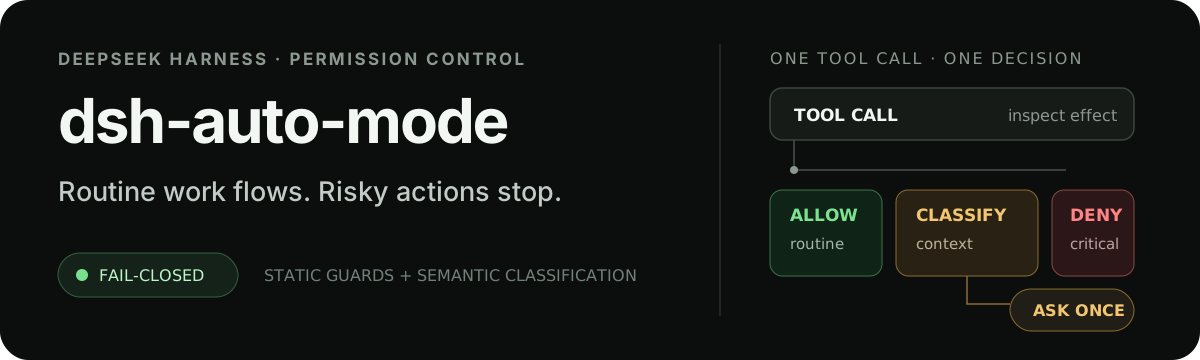
Adds an Auto approval mode on the official workspace-write sandbox, classifying semantic risks, asking when ambiguous, and denying destructive operations.

Undo/rollback system for DSH: config & plugin snapshots, one-click undo/redo/restore, message-level revert, secret masking, safe mode, and offline WebUI/GUI/CLI rescue tools for when DSH won't start.
Packages all 87 SKILL.md files from upstream reverse-skill as a DeepSeek Harness plugin that auto-registers them for authorized reverse engineering, penetration testing, and security research.
Dockyard DSH is a native DeepSeek Harness plugin that unifies official OAuth/client sessions for Codex, Antigravity, Grok, Claude, and Cursor, providing account pool, model catalog, and quota status.