auditrail
Run the following command in DeepSeek Harness:
dsh plugin install JohnXu22786/auditrail
Paste the following prompt into your AI chat to install this plugin:
Install it in DeepSeek Harness by running dsh plugin install JohnXu22786/auditrail; the full source is available at https://github.com/JohnXu22786/auditrail.
About this plugin
The DeepSeek Harness (dsh) ecosystem already ships observability bundles for performance (OpenTelemetry, Prometheus), but nobody was recording a security audit trail. auditrail closes that gap. It mounts as a dsh bundle, subscribes to the session event stream and the live tool pipeline, and records—per invocation—who ran what, when, which files and network targets were touched, the result status, and the duration—producing a single, tamper-evident audit chain.
Privacy and forensics coexist by design. Every row is masked and truncated before it touches SQLite (WAL): keys, bearer tokens, and high-entropy strings become labels, not secret values. A SHA-256 hash chain links each record to the previous one, so auditrail chain verify will flag any tampered or reordered line. Fourteen built-in sensitive-operation rules (rm -rf, curl | sh, sudo su, git force-push, and more) tag records with severity and rule IDs you can filter, query, and export.
Four model-facing tools (audit_query, audit_export, audit_playback, audit_policy) and a standalone auditrail CLI share the same SQLite database, so you can query, export to JSON / Markdown / compliance JSONL, or slow-play the entire session as a plain-text terminal timeline—without launching the harness. If your team needs compliance evidence, post-incident forensics, or simply wants to know exactly which commands the model invoked and which files it touched, auditrail is the security-audit layer the dsh ecosystem has been missing.
Use Cases
- Post-incident forensics to trace every command, file, and network target the model touched
- Exporting hash-chained JSONL compliance reports for third-party validation
- Slow-playing a full session in a plain-text terminal to review high-risk operation timing
Best For
- DSH operations teams that must meet security compliance and audit-retention mandates
- Developers who need post-incident forensics to investigate anomalous model behavior
- Architects building custom DSH platforms that require a built-in security-audit layer
Related Plugins
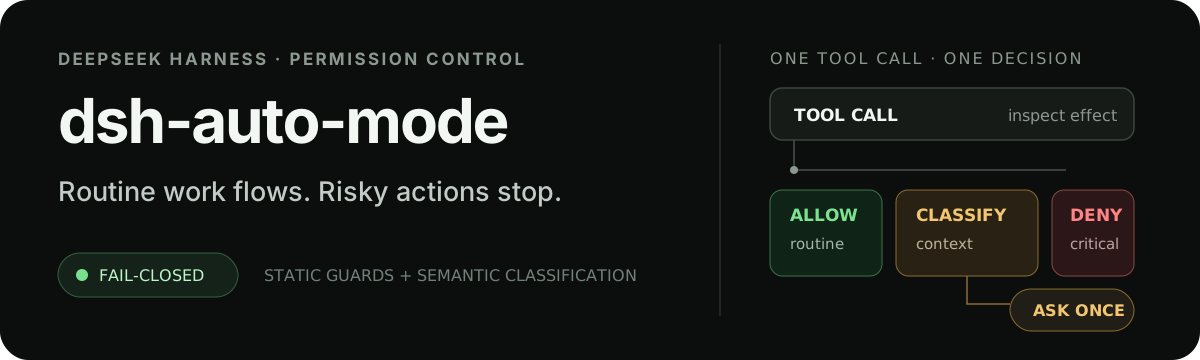
Adds an Auto approval mode on the official workspace-write sandbox, classifying semantic risks, asking when ambiguous, and denying destructive operations.

Undo/rollback system for DSH: config & plugin snapshots, one-click undo/redo/restore, message-level revert, secret masking, safe mode, and offline WebUI/GUI/CLI rescue tools for when DSH won't start.
Packages all 87 SKILL.md files from upstream reverse-skill as a DeepSeek Harness plugin that auto-registers them for authorized reverse engineering, penetration testing, and security research.
Dockyard DSH is a native DeepSeek Harness plugin that unifies official OAuth/client sessions for Codex, Antigravity, Grok, Claude, and Cursor, providing account pool, model catalog, and quota status.