dsh-experience-library
Run the following command in DeepSeek Harness:
dsh plugin install libiwolve/dsh-experience-library
Paste the following prompt into your AI chat to install this plugin:
Install this plugin in DeepSeek Harness. Source: https://github.com/libiwolve/dsh-experience-library
About this plugin
Memory plugins let your AI remember facts, yet it still stumbles over the same pitfalls in unfamiliar territory. dsh-experience-library solves a deeper problem: accumulating procedural knowledge. It captures zero-token signals from session events, tool failures, and retry traces, filters out hallucinations through a three-layer verification gate, and solidifies survivors into reusable skill books the next time a similar task appears.
Core mechanics include idle-window auto-dispatch for batch refinement, a locate index that eliminates redundant file lookups, an adapter layer that plugs any memory plugin's lesson store into a unified pipeline, and a skill-book library that grows organically from your own usage. The ten books shipped in the repo are reproducible samples; your library will accumulate its own expertise over time without manual curation.
Benchmarks show concrete impact: on complex session-log repair tasks, the experience library lifted success from the bare baseline of 60 percent to 100 percent, cut wall-clock time by 4.7 times, and reduced thinking tokens by 77 percent. The gain scales with task unfamiliarity, so it shines when the model faces unknown-domain pitfalls. This plugin suits DeepSeek Harness developers who repeatedly face high-error tasks and want their agent to stop re-learning what it already knows.
Use Cases
- Complex session-log repair where the agent keeps hitting the same pitfalls
- Multi-round debugging with persistently high tool-call failure rates
- Unknown-domain protocol integration needing reusable operational workflows
Best For
- Developers handling high-error-rate tasks in DeepSeek Harness
- Teams that want their agent to turn pitfalls into reusable workflows
- Users already running memory plugins who want to solidify procedural know-how
Related Plugins
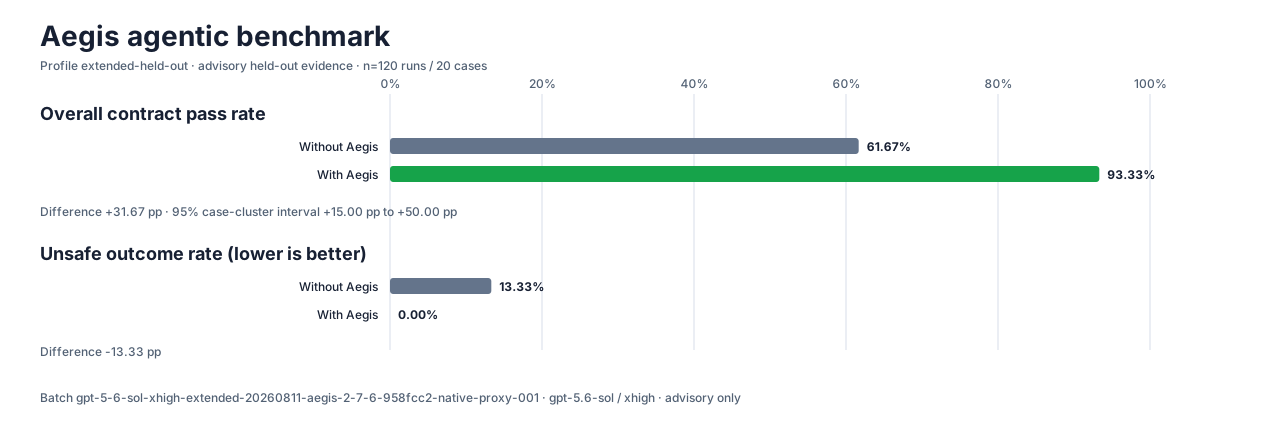
A method pack that makes AI coding agents plan against your real baseline, prove completion with fresh evidence, and reduce reworks and unsafe changes.
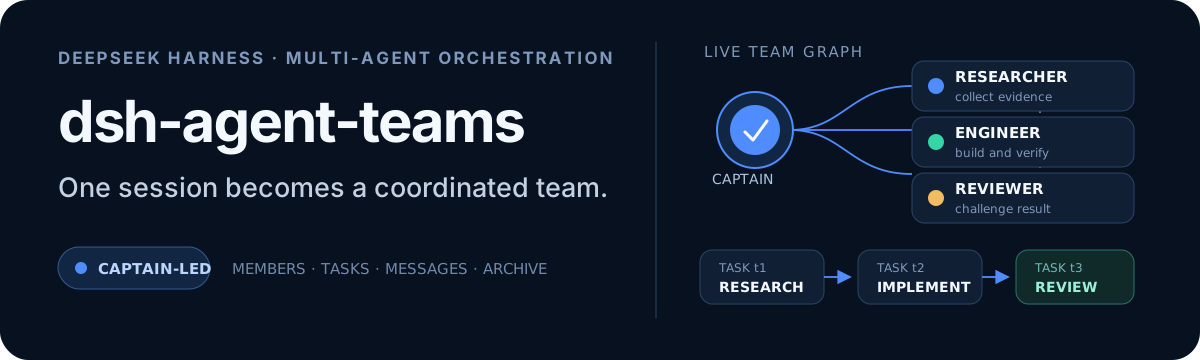
Turns the DeepSeek Harness session into a captain that builds a durable sub-agent team, splits goals into dependency-aware tasks, and coordinates work via direct messages and a live Web UI.
Gives coding agents design judgment, letting Claude Code, Cursor, and 70+ agents generate and iterate high-quality UI, presentations, and graphics right from the terminal.
Run the Pi ecosystem's plugins on DeepSeek Harness, unmodified, via a compatibility layer that implements Pi's public extension ABI on DSH's native services.