dsh-petrinet
Run the following command in DeepSeek Harness:
dsh plugin install yxie2/dsh-petrinet
Paste the following prompt into your AI chat to install this plugin:
Run dsh plugin install yxie2/dsh-petrinet in your DeepSeek Harness to install the plugin; full source is available at https://github.com/yxie2/dsh-petrinet .
About this plugin
When several agents collaborate on a long-horizon objective, the costliest failure modes are silent deadlocks, lock inversion, and uncontrolled concurrency. Traditional orchestration leans on scattered conditionals and manual token hand-offs that are hard to audit and impossible to verify before a single step runs.
dsh-petrinet models a plan as a Petri net: tokens drift through places, transitions consume and produce them, and one unified firing rule simultaneously expresses concurrency caps, loops, and runtime fan-out. Before a plan is committed to the durable log, a static soundness gate enumerates the reachability graph and either proves van der Aalst's three workflow-net conditions or hands back a concrete deadlock marking as a counterexample. The execution event stream doubles as a process-mining log, so the runtime can score a proposed repair against what actually happened and apply fixes in layers—from free, history-derived parameter tweaks to an LLM-authored replacement spec—each still passing the soundness gate before it ships.
It suits teams running multi-step, multi-agent workflows inside DeepSeek Harness that need provable resource bounds and a failure mode that surfaces at planning time rather than after forty hours of runtime.
Use Cases
- Coordinating multiple agents on a long-horizon task with pre-commit deadlock elimination
- Multi-step concurrent workflows that require hard resource caps such as API quotas or repo locks
- Mining execution history to detect plan drift and apply tiered self-repair
Best For
- Developers orchestrating multi-agent workflows inside DeepSeek Harness
- Platform engineers who need provable concurrency safety and pre-execution static checks
- System architects focused on workflow observability and self-healing capabilities
Related Plugins
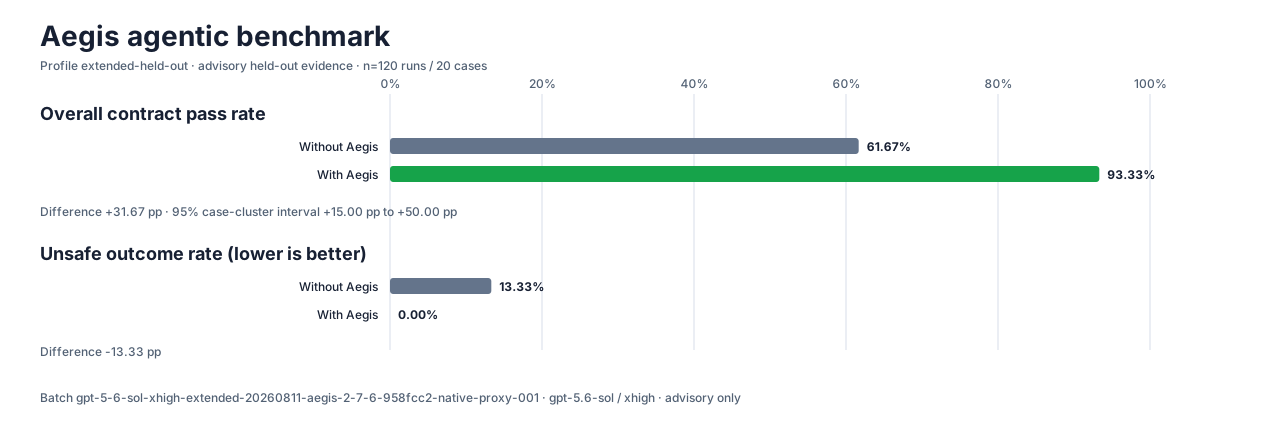
A method pack that makes AI coding agents plan against your real baseline, prove completion with fresh evidence, and reduce reworks and unsafe changes.
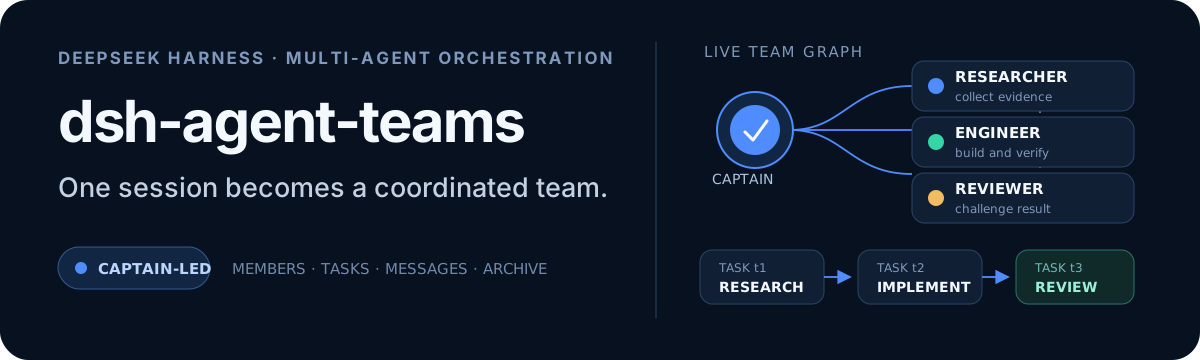
Turns the DeepSeek Harness session into a captain that builds a durable sub-agent team, splits goals into dependency-aware tasks, and coordinates work via direct messages and a live Web UI.
Gives coding agents design judgment, letting Claude Code, Cursor, and 70+ agents generate and iterate high-quality UI, presentations, and graphics right from the terminal.
Run the Pi ecosystem's plugins on DeepSeek Harness, unmodified, via a compatibility layer that implements Pi's public extension ABI on DSH's native services.