dsh-poor-router
Run the following command in DeepSeek Harness:
dsh plugin install yishengdaxiaonengjihui/dsh-poor-router
Paste the following prompt into your AI chat to install this plugin:
Install this plugin in DeepSeek Harness by running dsh plugin install yishengdaxiaonengjihui/dsh-poor-router; the full source repository is at https://github.com/yishengdaxiaonengjihui/dsh-poor-router
About this plugin
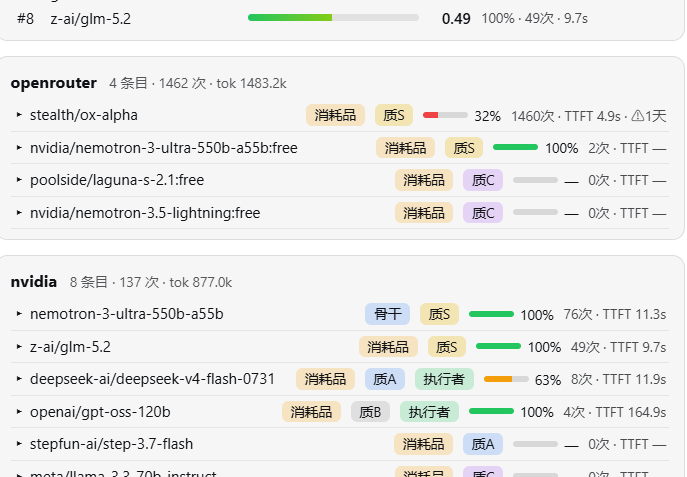
Free LLM capacity is scattered across NVIDIA bonus credits, Qwen giveaway grants, GLM flash tiers, and OpenRouter :free routes, each one expiring on its own schedule. You are mid-sentence when a model flatlines; you scramble to the next provider and find it barely breathing. dsh-poor-router treats every piece of free or cheap capacity as one pooled ledger: it meters every request, samples live health per entry, and swaps the model the instant a provider dies, so your session never notices a hiccup.
Routing is driven by Thompson sampling: each model entry carries a Beta posterior built from success and fail counts, and the per-request draw is further weighted by a TTFT latency penalty and the current-hour congestion bucket, so probability—not guesswork—picks the healthiest entry at the moment of routing. Auxiliary and trivial sub-requests are sent to whichever executor model still has the thickest remaining grant, with an epsilon-explore slot every sixth call to probe unused tiers. Only when every free candidate is dead does the escape hatch release the cheapest capped paid model, and a single SMS alerts you that real money was spent. At the provider level, AUTH or QUOTA-class failures cool the endpoint for ten minutes, 429 responses for ninety seconds, and all cooldowns persist across restarts.
The plugin is stateless per request: every call starts from your configured model and may be swapped for that one invocation only—your settings are never permanently altered. It also works fully headless; the two registered agent tools function without the web panel or the input-box badge. It is built for solo developers and small teams who survive on fragmented free and budget LLM quotas. If you can afford API bills, walk away; if you live on free credits, this is your routing brain.
Screenshots
Use Cases
- Aggregating free models from NVIDIA, Qwen, GLM, and OpenRouter with real-time health-based routing
- Resilient failover when free models time out or drop mid-stream, seamlessly swapping to same-tier peers
- Routing auxiliary sub-requests to the executor model with the thickest remaining grant to conserve primary quota
Best For
- Solo developers who rely on fragmented free and budget LLM quotas
- Small teams that need strict control over API spend
- Engineers managing multiple LLM providers and wanting a unified routing layer
Related Plugins
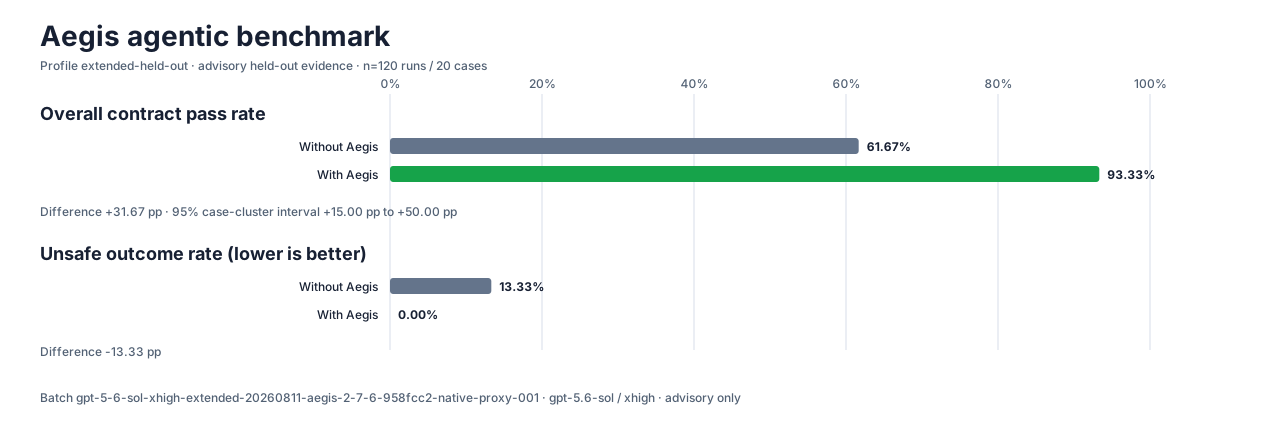
A method pack that makes AI coding agents plan against your real baseline, prove completion with fresh evidence, and reduce reworks and unsafe changes.
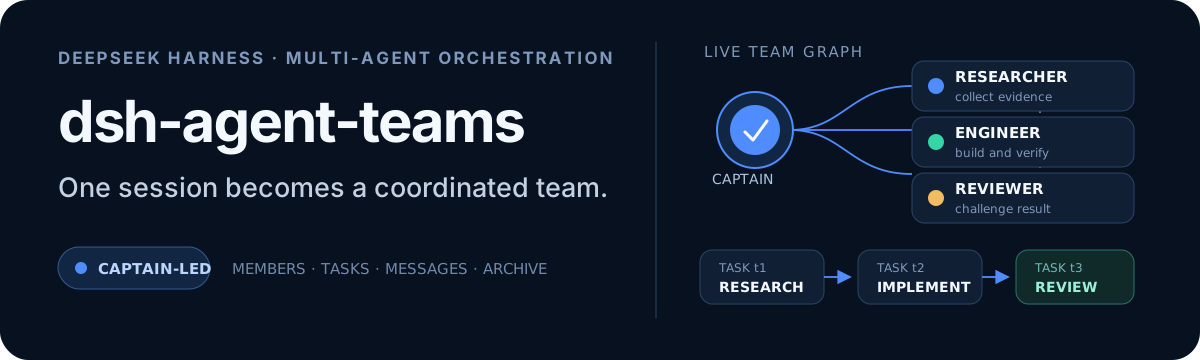
Turns the DeepSeek Harness session into a captain that builds a durable sub-agent team, splits goals into dependency-aware tasks, and coordinates work via direct messages and a live Web UI.
Gives coding agents design judgment, letting Claude Code, Cursor, and 70+ agents generate and iterate high-quality UI, presentations, and graphics right from the terminal.
Run the Pi ecosystem's plugins on DeepSeek Harness, unmodified, via a compatibility layer that implements Pi's public extension ABI on DSH's native services.