dsh-anywhere
Run the following command in DeepSeek Harness:
dsh plugin install tangwenhao616-netizen/dsh-anywhere
Paste the following prompt into your AI chat to install this plugin:
Run dsh plugin install tangwenhao616-netizen/dsh-anywhere in DeepSeek Harness to install; source is at https://github.com/tangwenhao616-netizen/dsh-anywhere
About this plugin
Your DeepSeek Harness runs locally, but the machine that actually needs the work may sit behind residential NAT, live in a cloud VPS, or be on an entirely different network. Every read, write, edit, bash, and grep lands on the local box, forcing you to scp files back and forth and work in a disconnected, error-prone loop.
dsh-anywhere adds two composable layers. The fleet layer enrolls a NAT-bound machine into your cluster with a one-time token and a reverse tunnel, exposing it as a dsh-ssh host that the existing ssh_exec and ssh_upload tools can drive. The world layer goes further: it promotes any SSH-reachable host into the session ctx.fs and ctx.subprocess, so the agent native file and shell tools operate directly on that remote machine with zero code changes. Use them independently or stack them: fleet to punch through NAT, then world to make the entire session workspace that remote box.
If you have a home server, a cloud VM, or an office machine where you want the agent to read files, run commands, and edit code in place instead of shuttling data across the wire, this plugin is built for you. It carries zero external npm dependencies, rides a single OpenSSH ControlMaster connection for roughly 40 ms per file operation, and has been validated end-to-end against a real Windows host.
Use Cases
- Turn a home server behind NAT into the agent native workspace for direct file I/O and shell commands
- Promote a cloud VM to the session working directory and eliminate manual file shuttling
- Enroll multiple LAN machines via fleet reverse tunnels and drive them as unified dsh-ssh hosts
Best For
- Developers who need the agent to read files and run commands directly on a restricted or remote host
- DevOps engineers managing a fleet of servers spread across multiple network segments
- Solo developers working between a home lab and cloud VMs who want a seamless remote experience
Related Plugins
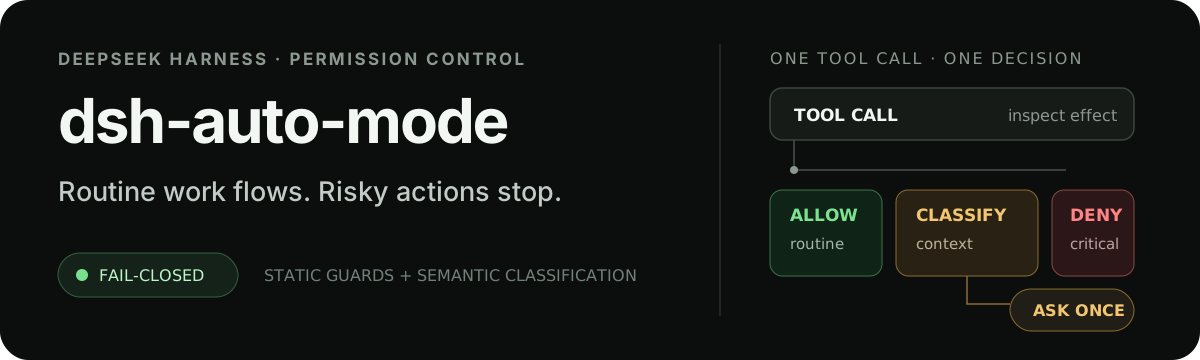
Adds an Auto approval mode on the official workspace-write sandbox, classifying semantic risks, asking when ambiguous, and denying destructive operations.

Undo/rollback system for DSH: config & plugin snapshots, one-click undo/redo/restore, message-level revert, secret masking, safe mode, and offline WebUI/GUI/CLI rescue tools for when DSH won't start.
Packages all 87 SKILL.md files from upstream reverse-skill as a DeepSeek Harness plugin that auto-registers them for authorized reverse engineering, penetration testing, and security research.
Dockyard DSH is a native DeepSeek Harness plugin that unifies official OAuth/client sessions for Codex, Antigravity, Grok, Claude, and Cursor, providing account pool, model catalog, and quota status.