hooks-adapter
Run the following command in DeepSeek Harness:
dsh plugin install JohnXu22786/hooks-adapter
Paste the following prompt into your AI chat to install this plugin:
Run dsh plugin install JohnXu22786/hooks-adapter in your shell to install from https://github.com/JohnXu22786/hooks-adapter; once loaded, dsh will automatically discover and adapt hooks configs in project and user directories.
About this plugin
You spent an evening tuning PreToolUse interceptors in Claude Code, wrote a few PostToolUse callbacks for Codex, and then switched to DeepSeek Harness only to find none of those configs are recognized. hooks-adapter is the compatibility layer built for exactly that gap: it reads your existing hook declarations read-only—never migrating or rewriting them—and maps the event names from Claude, Codex, and opencode dialects onto dsh extension points, so the same config keeps working as-is.
At execution time it supports four handler kinds: shell commands, HTTP webhooks, LLM evaluation (oracle), and subagent delegation (proxy), each with its own timeout and failure-degradation policy. Multiple hooks fold deterministically under deny > ask > allow, context accumulates in declaration order, and a validate subcommand surfaces config issues before they ever hit a live run. Zero runtime dependencies beyond Node 18 keep the footprint minimal.
If you have already built hook-based workflows—blocking risky tool calls, injecting project context into prompts, gating output quality through an LLM judge, or delegating repetitive steps to a subagent—and you do not want to rewrite any of it for dsh, hooks-adapter is the shortest bridge between your existing setup and the new harness.
Use Cases
- Reuse PreToolUse interceptors authored for Claude Code without rewriting them for dsh
- Gate tool-call quality through an LLM oracle and share the same prompt config across Codex and dsh
- Wire the same webhook approval callbacks into different harnesses instead of maintaining per-platform duplicates
Best For
- Developers who have built hook-based workflows on Claude, Codex, or opencode
- Platform engineers standardizing interception and approval policies across multiple agent harnesses
- Researchers evaluating tool-call quality via LLM judges without duplicating config per runtime
Related Plugins
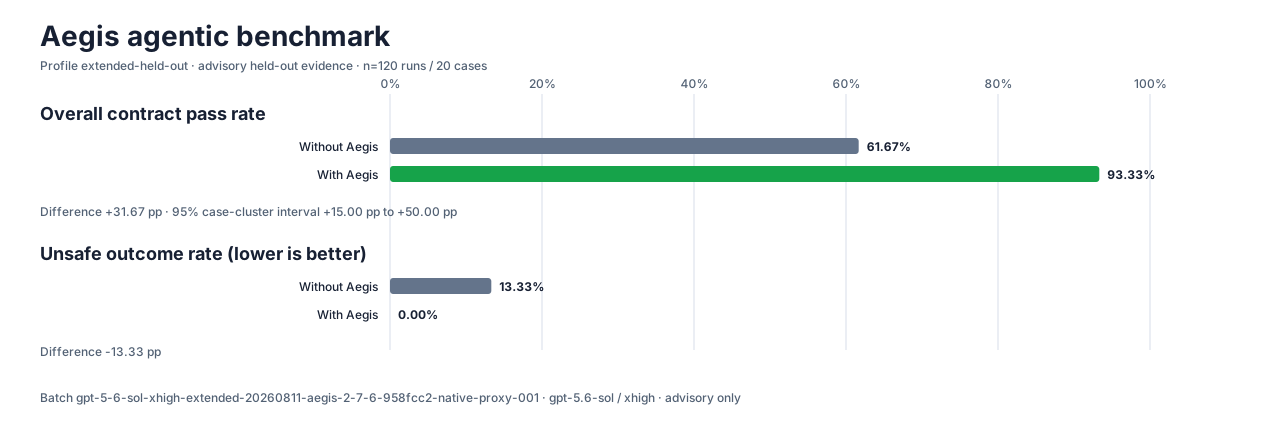
A method pack that makes AI coding agents plan against your real baseline, prove completion with fresh evidence, and reduce reworks and unsafe changes.
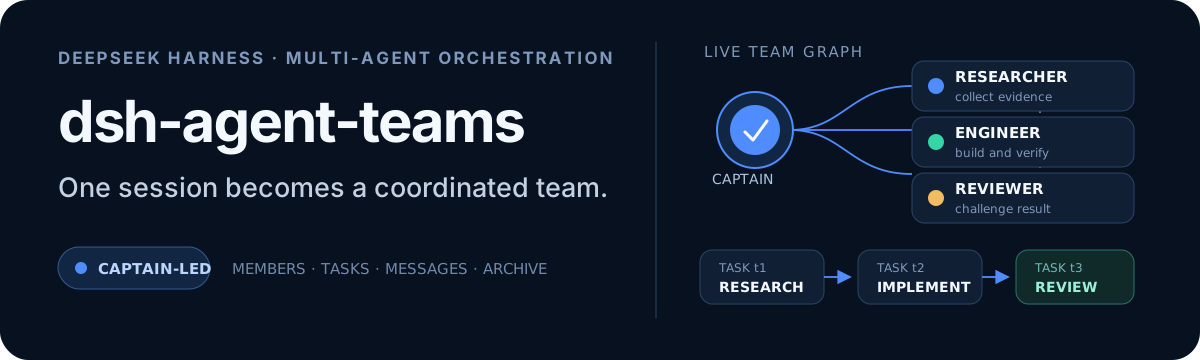
Turns the DeepSeek Harness session into a captain that builds a durable sub-agent team, splits goals into dependency-aware tasks, and coordinates work via direct messages and a live Web UI.
Gives coding agents design judgment, letting Claude Code, Cursor, and 70+ agents generate and iterate high-quality UI, presentations, and graphics right from the terminal.
Run the Pi ecosystem's plugins on DeepSeek Harness, unmodified, via a compatibility layer that implements Pi's public extension ABI on DSH's native services.