dsh-secret-paste
Run the following command in DeepSeek Harness:
dsh plugin install zhujiaqi/dsh-secret-paste
Paste the following prompt into your AI chat to install this plugin:
Visit https://github.com/zhujiaqi/dsh-secret-paste for documentation, then run `dsh plugin install zhujiaqi/dsh-secret-paste` in your terminal to install the plugin in DeepSeek Harness.
About this plugin
You paste an API key or token into the chat composer and it flows straight into the model's context, the session log, and every transcript—exactly where a secret should never land. dsh-secret-paste intercepts that moment: a detection engine identifies the credential, writes the real value into a local credentials file with 0600 permissions, and replaces it in your draft with a [secret:PASTE_N] placeholder. From that point on, messages, session history, and transcripts contain only the placeholder; the plaintext lives in exactly two places—this tab's memory and the credential file.
Detection is deliberately conservative. Drawing on 1,100+ rules derived from gitleaks and TruffleHog, the plugin splits hits into two tiers: high-confidence secrets (ghp_, sk-proj-, JWT, and similar) are auto-hidden immediately with a dismissible chip; medium-confidence matches (e.g. a Bearer prefix) surface a confirm-or-ignore prompt so you stay in control. Formats the detector cannot classify are never guessed—a manual "Mark selection as secret" action is provided as the fallback. On the model side, a dedicated secret_resolve tool returns the real value only when the model explicitly asks for it, and the tool's description instructs the model never to echo, repeat, or write the value into a reply, file, command, or tool argument, adding a second layer of leak prevention.
If you regularly handle tokens, API keys, JWTs, or other sensitive credentials inside DeepSeek Harness Web and want them kept out of plaintext conversations, session logs, and model context, this plugin gives you a local, zero-extra-server-route protection layer with a conservative, human-in-the-loop detection model.
Use Cases
- Auto-replacing pasted API keys or tokens with [secret:REF] placeholders so plaintext never reaches messages or session history
- Surfacing a confirm-or-ignore prompt for medium-confidence credentials such as Bearer tokens before storage
- Letting the model fetch a stored secret on demand via secret_resolve while the tool explicitly forbids echoing or writing the value
Best For
- Developers who regularly paste and work with API keys or tokens in DeepSeek Harness Web
- Security-conscious users who must keep credentials out of session logs and model context
- Teams that handle credentials through CI pipelines or AI agent automation
Related Plugins
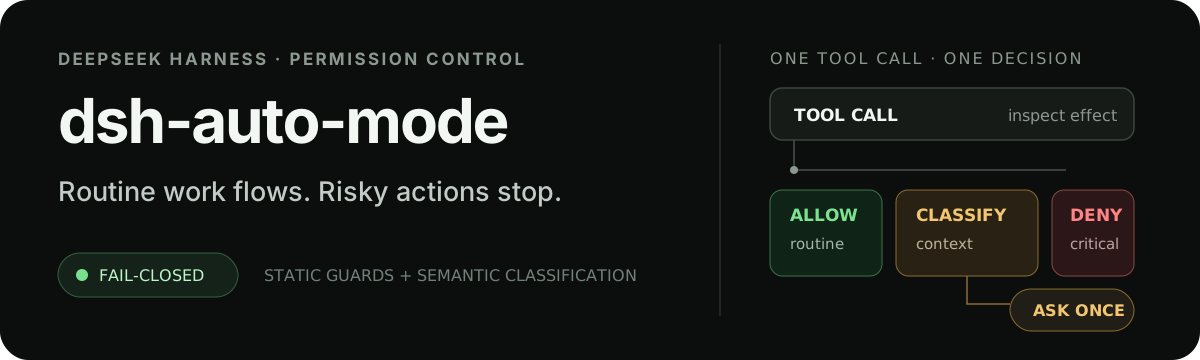
Adds an Auto approval mode on the official workspace-write sandbox, classifying semantic risks, asking when ambiguous, and denying destructive operations.

Undo/rollback system for DSH: config & plugin snapshots, one-click undo/redo/restore, message-level revert, secret masking, safe mode, and offline WebUI/GUI/CLI rescue tools for when DSH won't start.
Packages all 87 SKILL.md files from upstream reverse-skill as a DeepSeek Harness plugin that auto-registers them for authorized reverse engineering, penetration testing, and security research.
Dockyard DSH is a native DeepSeek Harness plugin that unifies official OAuth/client sessions for Codex, Antigravity, Grok, Claude, and Cursor, providing account pool, model catalog, and quota status.