dsh-agent-life
Run the following command in DeepSeek Harness:
dsh plugin install jonah791/dsh-agent-life
Paste the following prompt into your AI chat to install this plugin:
To install this plugin in DeepSeek Harness, please run dsh plugin install jonah791/dsh-agent-life. Source: https://github.com/jonah791/dsh-agent-life
About this plugin
Agent shouldn't just be mechanical; they need a sense of 'breathing' and 'perception.' dsh-agent-life is designed to solve the chaos of state management during long-running Agent sessions. It provides the primitives of a digital life cycle, allowing the Agent to autonomously decide when to sleep and what to do upon waking, effectively eliminating the need for tedious hard-coded rules.
The core capability lies in its 'zero rules' philosophy. With life_sleep, the Agent can perform interruptible in-process waiting, ensuring that any master message instantly cuts off the sleep state. Paired with life_status, it precisely tracks the current time, scheduled sleep, and guardian incident records. Additionally, the hourly chime mechanism intelligently injects time context at the end to avoid cache misses while ensuring information freshness.
This plugin is ideal for developers seeking to imbue their Agents with greater autonomy and human-like characteristics. Whether building intelligent assistants that require long periods of dormancy or complex workflows where Agents need to feel the passage of time, dsh-agent-life is a lightweight yet powerful tool, allowing digital lives to flow naturally within the DSH Harness ecosystem.
Use Cases
- Agent needs to autonomously sleep to save compute resources
- Need to interrupt sleep in real-time when handling sudden messages
- Need to record Agent lifecycle states and incidents
Best For
- Engineers who wish to endow Agents with human-like characteristics
- Workflow developers needing to manage long-running Agents
- Architects who prefer zero-rules, fully autonomous decision-making modes
Related Plugins
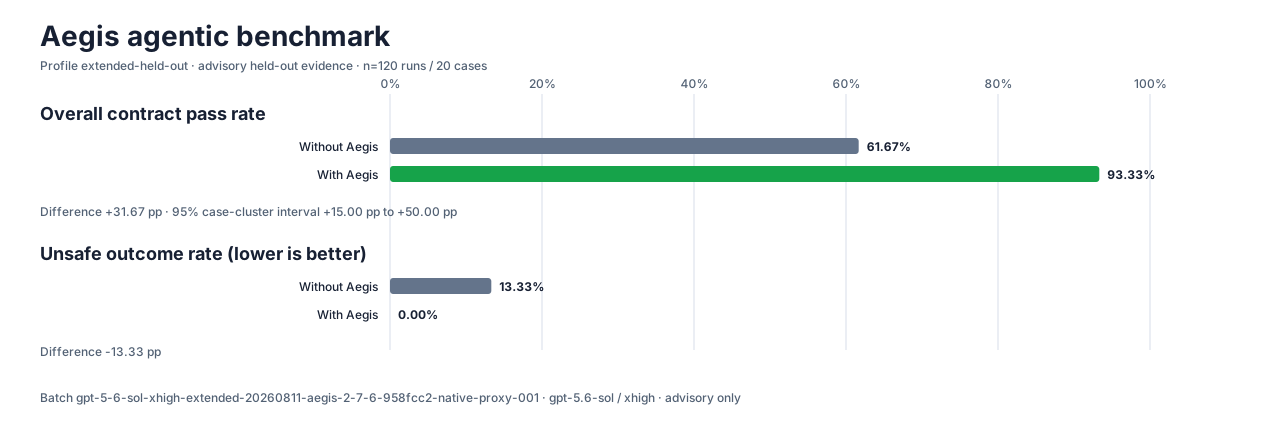
A method pack that makes AI coding agents plan against your real baseline, prove completion with fresh evidence, and reduce reworks and unsafe changes.
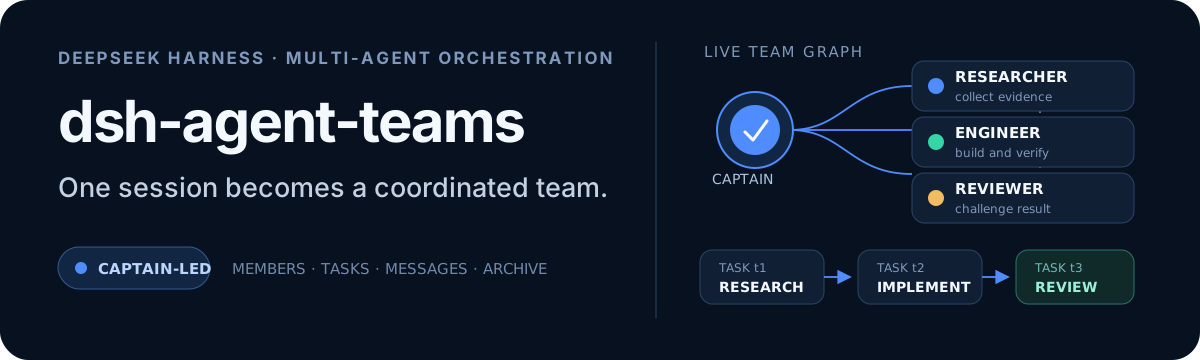
Turns the DeepSeek Harness session into a captain that builds a durable sub-agent team, splits goals into dependency-aware tasks, and coordinates work via direct messages and a live Web UI.
Gives coding agents design judgment, letting Claude Code, Cursor, and 70+ agents generate and iterate high-quality UI, presentations, and graphics right from the terminal.
Run the Pi ecosystem's plugins on DeepSeek Harness, unmodified, via a compatibility layer that implements Pi's public extension ABI on DSH's native services.