dsh-code-security
Run the following command in DeepSeek Harness:
dsh plugin install STARDUSTLC666/dsh-code-security
Paste the following prompt into your AI chat to install this plugin:
To install this plugin in DeepSeek Harness, please run the command dsh plugin install STARDUSTLC666/dsh-code-security, with the source code repository at https://github.com/STARDUSTLC666/dsh-code-security.
About this plugin
While AI code generation boosts productivity, it often introduces hidden risks such as injection vulnerabilities and hardcoded credentials that traditional review processes miss, leading to "delivery with defects." dsh-code-security serves as the final security checkpoint for AI Agents within the DeepSeek Harness ecosystem. It acts as a deterministic gatekeeper that enforces local security scanning before code is officially released, ensuring every change is verified. Its core strength lies in an incremental review mechanism that leverages git diff to scan only new code, optimizing performance while maintaining strict security. The plugin covers 40+ vulnerability categories, including injection, deserialization, weak encryption, and sensitive information leaks. By generating objective evidence like CWE codes and code snippets instead of just suggestions, and utilizing tools like secure_fix_verify, it enables a closed-loop process where Agents can automatically confirm the resolution of issues. Designed for developers and DevOps teams building automated workflows, dsh-code-security offers a flexible solution through custom policy gateways and baseline management. Teams can define specific thresholds and exclusions via .code-security.. As a lightweight tool with zero runtime dependencies, it integrates seamlessly into DeepSeek Harness environments, allowing users to leverage AI coding benefits without compromising on security standards.
Use Cases
- Integrate into CI/CD pipelines to enforce security scanning before code delivery.
- Automatically review AI-generated code to block common vulnerabilities like injection and deserialization.
- Verify automated fixes to ensure vulnerabilities are truly resolved without introducing new risks.
Best For
- DevOps engineers building automated security pipelines.
- Developers using AI-assisted coding who want to improve code quality.
- Security teams requiring code gates and policy management.
Related Plugins
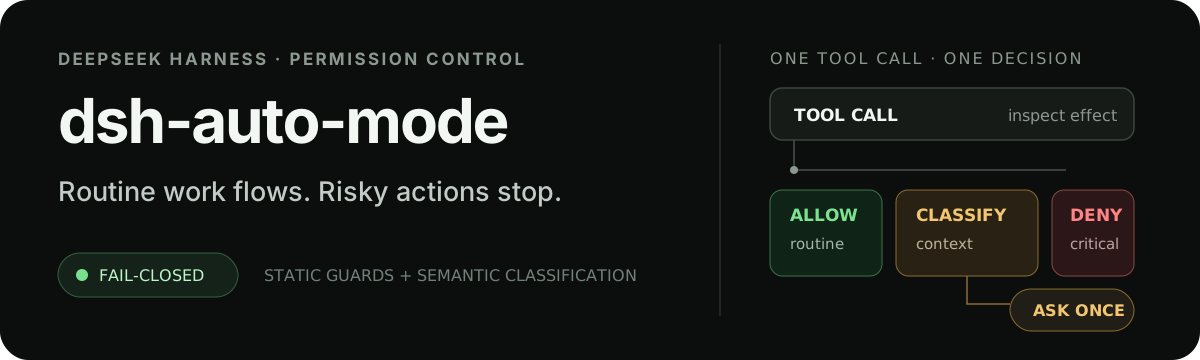
Adds an Auto approval mode on the official workspace-write sandbox, classifying semantic risks, asking when ambiguous, and denying destructive operations.

Undo/rollback system for DSH: config & plugin snapshots, one-click undo/redo/restore, message-level revert, secret masking, safe mode, and offline WebUI/GUI/CLI rescue tools for when DSH won't start.
Packages all 87 SKILL.md files from upstream reverse-skill as a DeepSeek Harness plugin that auto-registers them for authorized reverse engineering, penetration testing, and security research.
Dockyard DSH is a native DeepSeek Harness plugin that unifies official OAuth/client sessions for Codex, Antigravity, Grok, Claude, and Cursor, providing account pool, model catalog, and quota status.