DHS-multi-agent-plugin
Run the following command in DeepSeek Harness:
dsh plugin install Li3NGa/DHS-multi-agent-plugin
Paste the following prompt into your AI chat to install this plugin:
In DeepSeek Harness, you can install this plugin using the command dsh plugin install Li3NGa/DHS-multi-agent-plugin, with the full source code available at https://github.com/Li3NGa/DHS-multi-agent-plugin.
About this plugin
In complex AI applications, a single agent often struggles with multi-step or collaborative tasks, leading to inefficient automation workflows. The DHS-multi-agent-plugin solves this by providing a multi-agent orchestration runtime that lets users define agent teams and automatically coordinate their interactions using six collaboration strategies and structured task graphs.
Its core strengths lie in flexible orchestration and robust runtime support. It offers six strategies—broadcast, sequential, debate, supervisor, consensus, and relay—paired with a DAG scheduler for parallel task execution, along with features like budget control, timeout management, session isolation, response caching, and observability. This ensures efficient, reliable, and monitorable runs, with capability-based routing and fallback chains for fault tolerance.
The plugin is ideal for developers and researchers building multi-agent systems for use cases such as AI research, decision support, or workflow automation. With support for Python API, CLI, HTTP services, and MCP, it provides versatile integration options, allowing users to focus on business logic rather than low-level coordination.
Use Cases
- Collect multi-perspective views in parallel via broadcast strategy for brainstorming.
- Decompose complex tasks and automatically schedule parallel execution using supervisor strategy.
- Have multiple agents discuss in multiple rounds under debate strategy to converge decisions.
Best For
- AI developers building multi-agent systems.
- Enterprise technology teams seeking workflow automation.
- Researchers conducting complex task collaboration.
Related Plugins
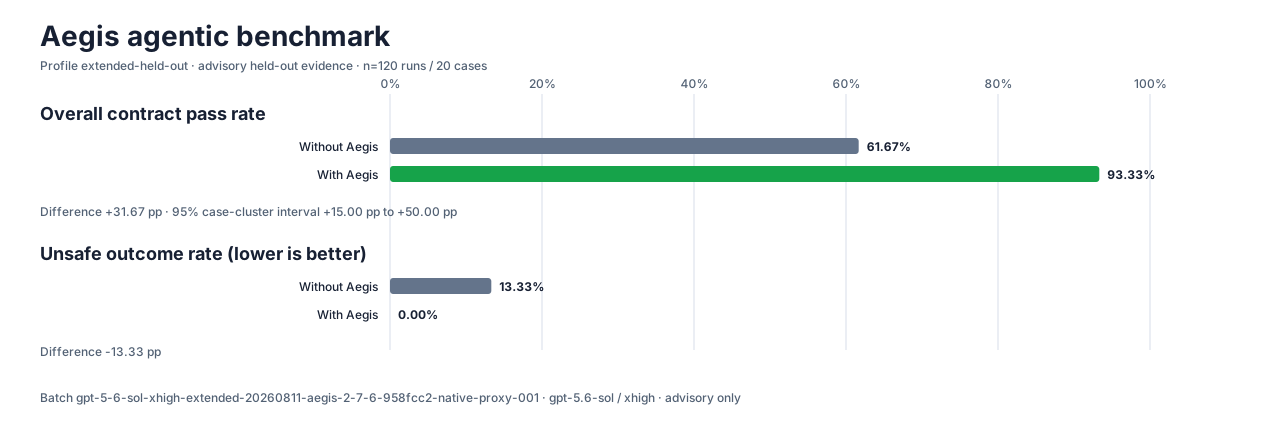
A method pack that makes AI coding agents plan against your real baseline, prove completion with fresh evidence, and reduce reworks and unsafe changes.
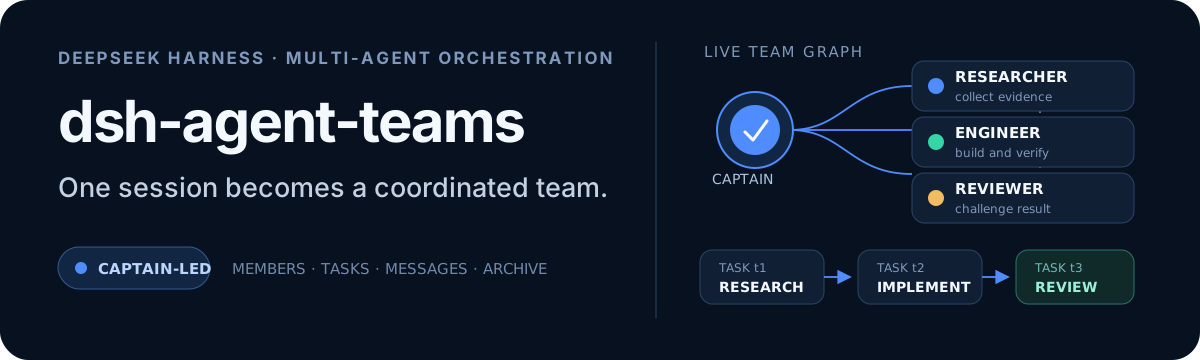
Turns the DeepSeek Harness session into a captain that builds a durable sub-agent team, splits goals into dependency-aware tasks, and coordinates work via direct messages and a live Web UI.
Gives coding agents design judgment, letting Claude Code, Cursor, and 70+ agents generate and iterate high-quality UI, presentations, and graphics right from the terminal.
Run the Pi ecosystem's plugins on DeepSeek Harness, unmodified, via a compatibility layer that implements Pi's public extension ABI on DSH's native services.