
GLM-5.2
About this model
GLM-5.2

👋 Join our WeChat or Discord community.
📖 Check out the GLM-5.2 blog and GLM-5 Technical report.
📍 Use GLM-5.2 API services on Z.ai API Platform.
🔜 Try GLM-5.2 here.
Introduction
We're introducing GLM-5.2, our latest flagship model for long-horizon tasks. It marks a substantial leap in long-horizon task capability over its predecessor GLM-5.1 and, for the first time, delivers that capability on a solid 1M-token context. GLM-5.2's new capabilities include: - Solid 1M Context: A solid 1M-token context that stably sustains long-horizon work - Advanced Coding with Flexible Effort: Stronger coding capabilities with multiple thinking effort levels to balance performance and latency - Improved Architecture: We propose IndexShare, which reuses the same indexer across every four sparse attention layers, reducing per-token FLOPs by 2.9× at a 1M context length. We also improve GLM-5.2’s MTP layer for speculative decoding, increasing the acceptance length by up to 20% - Pure Open: An MIT open-source license — no regional limits, technical access without borders
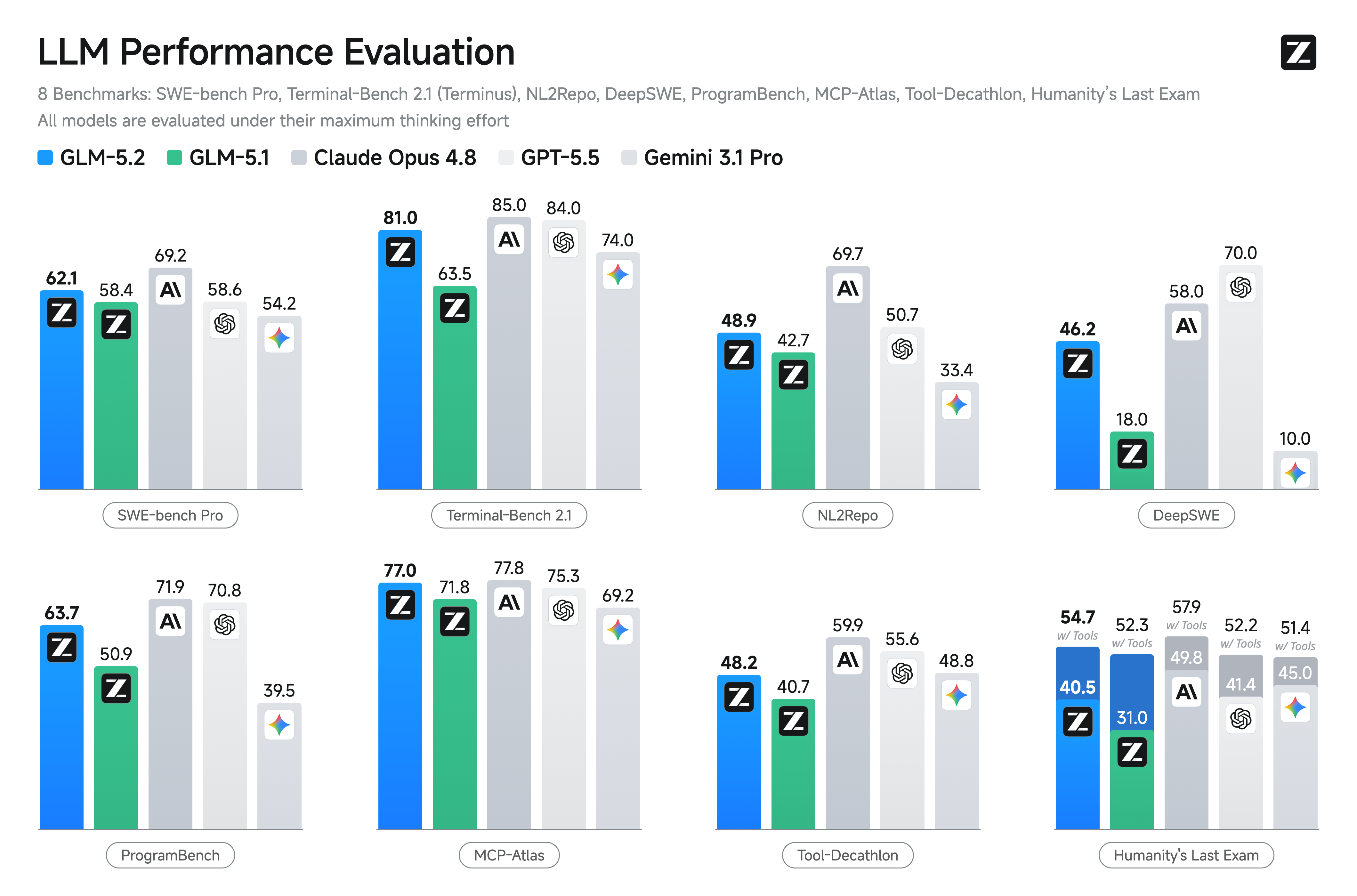
Benchmark
| Benchmark | GLM-5.2 | GLM-5.1 | Qwen3.7-Max | MiniMax M3 | DeepSeek-V4-Pro | Claude Opus 4.8 | GPT-5.5 | Gemini 3.1 Pro |
|---|---|---|---|---|---|---|---|---|
| Reasoning | ||||||||
| HLE | 40.5 | 31 | 41.4 | 37 | 37.7 | 49.8* | 41.4* | 45 |
| HLE (w/ Tools) | 54.7 | 52.3 | 53.5 | - | 48.2 | 57.9* | 52.2* | 51.4* |
| CritPt | 20.9 | 4.6 | 13.4 | 3.7 | 12.9 | 20.9 | 27.1 | 17.7 |
| AIME 2026 | 99.2 | 95.3 | 97 | - | 94.6 | 95.7 | 98.3 | 98.2 |
| HMMT Nov. 2025 | 94.4 | 94 | 95 | 84.4 | 94.4 | 96.5 | 96.5 | 94.8 |
| HMMT Feb. 2026 | 92.5 | 82.6 | 97.1 | 84.4 | 95.2 | 96.7 | 96.7 | 87.3 |
| IMOAnswerBench | 91.0 | 83.8 | 90 | - | 89.8 | 83.5 | - | 81 |
| GPQA-Diamond | 91.2 | 86.2 | 90 | 93 | 90.1 | 93.6 | 93.6 | 94.3 |
| Coding | ||||||||
| SWE-bench Pro | 62.1 | 58.4 | 60.6 | 59 | 55.4 | 69.2 | 58.6 | 54.2 |
| NL2Repo | 48.9 | 42.7 | 47.2 | 42.1 | 35.5 | 69.7 | 50.7 | 33.4 |
| DeepSWE | 46.2 | 18 | 18 | 20 | 8 | 58 | 70 | 10 |
| ProgramBench | 63.7 | 50.9 | - | - | 47.8 | 71.9 | 70.8 | 39.5 |
| Terminal Bench 2.1 (Terminus-2) | 81.0 | 63.5 | 75 | 65 | 64 | 85 | 84 | 74 |
| Terminal Bench 2.1 (Best Reported Harness) | 82.7 | 69 | - | - | - | 78.9 | 83.4 | 70.7 |
| FrontierSWE (Dominance) | 74.4 | 30.5 | - | - | 29.0 | 75.1 | 72.6 | 39.6 |
| PostTrainBench | 34.3 | 20.1 | - | - | - | 37.2 | 28.4 | 21.6 |
| SWE-Marathon | 13.0 | 1.0 | - | - | - | 26.0 | 12.0 | 4.0 |
| Agentic | ||||||||
| MCP-Atlas (Public Set) | 76.8 | 71.8 | 76.4 | 74.2 | 73.6 | 77.8 | 75.3 | 69.2 |
| Tool-Decathlon | 48.2 | 40.7 | - | - | 52.8 | 59.9 | 55.6 | 48.8 |
Serve GLM-5.2 Locally
GLM-5.2 supports deployment with the following frameworks. Feel free to try them out:
- SGLang (v0.5.13.post1+) — see cookbook
- vLLM (v0.23.0+) — see recipes
- Transformers (v0.5.12+) — see transformers docs
- KTransformers (v0.5.12+) — see tutorial
- Unsloth (v0.1.47-beta+) — see guide
- For deployment on the
Ascend NPUplatform, inference frameworks such as vLLM-Ascend, xLLM and SGLang are supported — see here.
Footnote
- Humanity’s Last Exam (HLE) & other reasoning tasks: We use sampling parameters of
temperature=1.0,top_p=0.95for evaluation. We evaluate with a maximum generation length of163,840tokens. By default, we report the text-only subset; results marked with * are from the full set. For AIME, HMMT and IMOAnswerBench, we evaluate each question using the following system prompt:Your response should be in the following format:\nExplanation: {your explanation for your final answer}\nExact Answer: {your succinct, final answer}\nConfidence: {your confidence score between 0% and 100% for your answer}.We use GPT-5.5 (medium) as the judge model. For HLE-with-tools, we use a maximum context length of 300,000 tokens, with no context management strategy. - SWE-Bench Pro: We run the SWE-Bench Pro suite with OpenHands using a tailored instruction prompt. Settings:
temperature=1,top_p=1,max_new_tokens=32k, with a 400K context window. - NL2Repo: We evaluated NL2Repo with
temperature=1.0,top_p=1.0, andmax_new_tokens=48kunder 400k context. To prevent hacking, we use rule-based and a LLM-based judgement to prevent malicious behaviors (e.g., unauthorized pip or curl operations). - DeepSWE: We run DeepSWE with the official pier evaluation framework and the mini-swe-agent harness (
temperature=1.0,top_p=1.0,timeout=2h, 400K context). Each task is solved in an isolated container with 2 CPUs, 8 GB RAM, and no internet access. - ProgramBench: We evaluate ProgramBench (200 instances) with Claude-Code 2.1.156 using
temperature=1.0, top_p=1.0, max_tokens=64000, max_turns=2000, sample_timeout=6h, reasoning_effort=max, with a 400K context window. Each instance runs in a (4 CPUs, 8 GB RAM) sandbox with internet access disabled. - Terminal-Bench 2.1 (Terminus 2): We evaluate Terminal-Bench 2.1 with Terminus-2 framework using
parser=json,timeout=4h,temperature=1.0,top_p=1.0,max_new_tokens=48k,max_episodes=500, with a 256K context window. Resource limits are capped at 4 CPUs and 8 GB RAM. - Terminal-Bench 2.1 (Claude Code): We evaluate in Claude Code 2.1.167 with
temperature=1.0, top_p=0.95, max_new_tokens=131072. We override max_new_tokens to 128k via a transparent proxy, bypassing the 64k CLI cap to restore the configurability ofCLAUDE_CODE_MAX_OUTPUT_TOKENS. We remove wall-clock time limits, while preserving per-task CPU and memory constraints. Scores are averaged over 5 runs. - MCP-Atlas: All models were evaluated in think mode on the 500-task public subset with a 10-minute timeout per task. We use Gemini-3.0-Pro as the judge model for evaluation.
- Tool-Decathlon: We use the official evaluation service and set max_token to 128K.
- FrontierSWE: The evaluation was conducted by Proximal with 1M context length, max effort level, and 128K maximum output tokens. Dominance score reported as of 2026/06/16.
- PostTrainBench: The evaluation was conducted by PostTrainBench with 1M context length, max effort level, and 128K maximum output tokens.
- SWE-Marathon: The evaluation was conducted by Abundant AI with 1M context length, max effort level, and 128K maximum output tokens.
Citation
If you find GLM-5.2 useful in your research, please cite our technical report:
@misc{glm5team2026glm5vibecodingagentic,
      title={GLM-5: from Vibe Coding to Agentic Engineering},
      author={GLM-5-Team and : and Aohan Zeng and Xin Lv and Zhenyu Hou and Zhengxiao Du and Qinkai Zheng and Bin Chen and Da Yin and Chendi Ge and Chenghua Huang and Chengxing Xie and Chenzheng Zhu and Congfeng Yin and Cunxiang Wang and Gengzheng Pan and Hao Zeng and Haoke Zhang and Haoran Wang and Huilong Chen and Jiajie Zhang and Jian Jiao and Jiaqi Guo and Jingsen Wang and Jingzhao Du and Jinzhu Wu and Kedong Wang and Lei Li and Lin Fan and Lucen Zhong and Mingdao Liu and Mingming Zhao and Pengfan Du and Qian Dong and Rui Lu and Shuang-Li and Shulin Cao and Song Liu and Ting Jiang and Xiaodong Chen and Xiaohan Zhang and Xuancheng Huang and Xuezhen Dong and Yabo Xu and Yao Wei and Yifan An and Yilin Niu and Yitong Zhu and Yuanhao Wen and Yukuo Cen and Yushi Bai and Zhongpei Qiao and Zihan Wang and Zikang Wang and Zilin Zhu and Ziqiang Liu and Zixuan Li and Bojie Wang and Bosi Wen and Can Huang and Changpeng Cai and Chao Yu and Chen Li and Chengwei Hu and Chenhui Zhang and Dan Zhang and Daoyan Lin and Dayong Yang and Di Wang and Ding Ai and Erle Zhu and Fangzhou Yi and Feiyu Chen and Guohong Wen and Hailong Sun and Haisha Zhao and Haiyi Hu and Hanchen Zhang and Hanrui Liu and Hanyu Zhang and Hao Peng and Hao Tai and Haobo Zhang and He Liu and Hongwei Wang and Hongxi Yan and Hongyu Ge and Huan Liu and Huanpeng Chu and Jia'ni Zhao and Jiachen Wang and Jiajing Zhao and Jiamin Ren and Jiapeng Wang and Jiaxin Zhang and Jiayi Gui and Jiayue Zhao and Jijie Li and Jing An and Jing Li and Jingwei Yuan and Jinhua Du and Jinxin Liu and Junkai Zhi and Junwen Duan and Kaiyue Zhou and Kangjian Wei and Ke Wang and Keyun Luo and Laiqiang Zhang and Leigang Sha and Liang Xu and Lindong Wu and Lintao Ding and Lu Chen and Minghao Li and Nianyi Lin and Pan Ta and Qiang Zou and Rongjun Song and Ruiqi Yang and Shangqing Tu and Shangtong Yang and Shaoxiang Wu and Shengyan Zhang and Shijie Li and Shuang Li and Shuyi Fan and Wei Qin and Wei Tian and Weining Zhang and Wenbo Yu and Wenjie Liang and Xiang Kuang and Xiangmeng Cheng and Xiangyang Li and Xiaoquan Yan and Xiaowei Hu and Xiaoying Ling and Xing Fan and Xingye Xia and Xinyuan Zhang and Xinze Zhang and Xirui Pan and Xu Zou and Xunkai Zhang and Yadi Liu and Yandong Wu and Yanfu Li and Yidong Wang and Yifan Zhu and Yijun Tan and Yilin Zhou and Yiming Pan and Ying Zhang and Yinpei Su and Yipeng Geng and Yong Yan and Yonglin Tan and Yuean Bi and Yuhan Shen and Yuhao Yang and Yujiang Li and Yunan Liu and Yunqing Wang and Yuntao Li and Yurong Wu and Yutao Zhang and Yuxi Duan and Yuxuan Zhang and Zezhen Liu and Zhengtao Jiang and Zhenhe Yan and Zheyu Zhang and Zhixiang Wei and Zhuo Chen and Zhuoer Feng and Zijun Yao and Ziwei Chai and Ziyuan Wang and Zuzhou Zhang and Bin Xu and Minlie Huang and Hongning Wang and Juanzi Li and Yuxiao Dong and Jie Tang},
      year={2026},
      eprint={2602.15763},
      archivePrefix={arXiv},
      primaryClass={cs.LG},
      url={https://arxiv.org/abs/2602.15763},
}
Editor's note
Written for AI Agent Hub. This is separate from the publisher description above.
What problem it solves
GLM-5.2 is an open listing with a long context window from zai-org in our data. It is for operators who want that base model. Quantized cards (NVFP4, FP8) are repacks for different hardware. They are not free quality.
Who it is for
People who have decided on open weights, have a machine in mind, and want a current GLM rather than a hosted Z.ai endpoint. You can tell a quantization from a base model.
Who should skip it
Skip the quantized row until the base row's license and behavior are acceptable. A smaller file that fails your prompt is not a savings. Skip GLM hosted endpoints if you came here to keep data local. The name collision is the same trap as Qwen and DeepSeek. Skip it if VRAM is unknown and you have no plan to measure it. The page's missing VRAM field means we do not know. Do not invent a figure from the parameter count.
First three steps
- Open the zai-org source, not a third-party quant, and read the license.
- Run a coding prompt you can grade if code is the job, or a long-context needle if the window is the job.
- Only then look at FP8 or NVFP4 if the base model worked and the hardware needs the smaller footprint. Re-run the same prompt. Keep the quant only if the grade holds.
Alternatives on this site
Kimi-K3 and the dated DeepSeek Flash weights are the neighboring open notes. A closed GLM or Claude row is the alternative when you want an API. How to read a listing tells you to write "unknown" for blank fields instead of filling them in from a sibling card.
Questions
Why does NVIDIA appear on some GLM rows? Those are repacks or hosts, not proof the base license changed. Read each row's company and source link.
Is 5.2 newer than 5.3 in our list? Look at the card you are configuring, not at the version arithmetic. A higher version string on a different host is a different artifact.
Benchmark Scores
Technical Specs
- Architecture: transformers
- Context Window: 1,048,576 tokens
- Input Modalities: text
Hardware Requirements
- API-only (no local hardware needed)
Pricing
| Input | Output | Currency |
|---|---|---|
| 1.19 / 1M tokens | 3.74 / 1M tokens | USD |
Related Models
More Open Source →
Description: The NVIDIA DeepSeek-V4-Pro-NVFP4 model is the quantized version of the DeepSeek-V4-Pro model, which is a Mixture-of-Experts (MoE) language model with 1.6 trillion total parameters and 49 billion activated parameters. For more information, please check here. The NVIDI…
Description: The NVIDIA GLM-5.2 NVFP4 model is the quantized version of ZAI’s GLM-5.2 model, which is an auto-regressive language model that uses an optimized transformer architecture. GLM-5.2 is a Mixture-of-Experts (MoE) model for reasoning and coding that uses sparse attention…
👋 Join our WeChat or Discord community. 📖 Check out the GLM-5.2 blog and GLM-5 Technical report . 📍 Use GLM-5.2 API services on Z.ai API Platform. 🔜 Try GLM-5.2 here .
Description: The NVIDIA DeepSeek-V4-Flash-NVFP4 model is a quantized version of DeepSeek AI's DeepSeek-V4-Flash model, an autoregressive Mixture-of-Experts language model that uses an optimized Transformer architecture with hybrid attention (Compressed Sparse Attention and Heavil…